Custom Toe Correctors
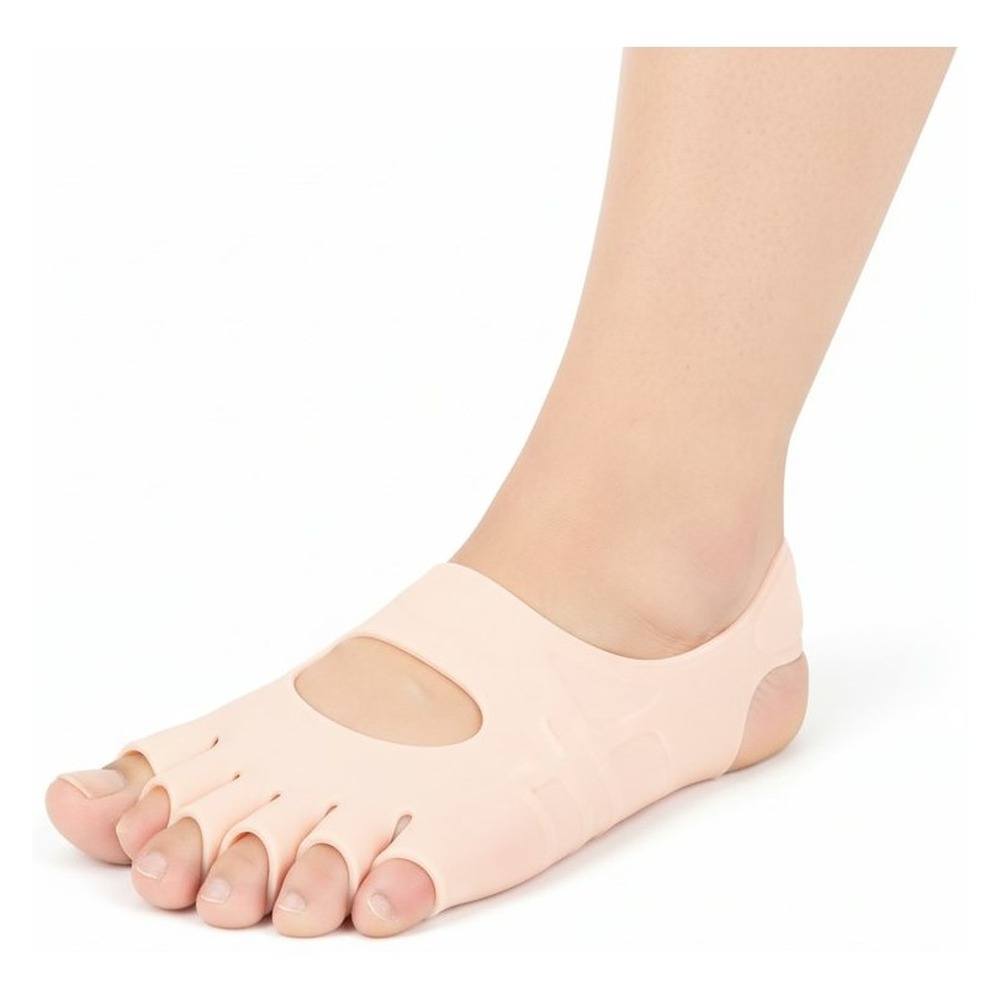
Toe correctors hold a toe in a better position rather than simply spacing it. The range covers soft day-and-night sleeves, silicone hammer-toe pads, pull bands and overlapping-toe splints.
What We Make In Toe Correctors
Each product is built around a soft loop or strap that can be adjusted, so the wearer can start with light tension and increase it over time.
- Day and night corrector sleeves
- Hammer-toe pads with toe loops
- Elastic pull bands and straps
- Overlapping-toe splints
Materials & Construction
Stretch fabric feels soft against the forefoot and disappears under a sock; silicone loops feel firmer and keep their shape through repeated pulls. The sewn wraps are the ones to hand-wash, while moulded parts can be wiped.
Customisation & Packing
We print the logo on the sleeve, band or card, pack with a wear guide, and can assemble a mixed corrector kit. Custom loop counts and tension are available on larger orders. Packing runs through our packaging and branding service, with dielines and artwork handled by the private label team.
- Any solid colour, Pantone matched
- Logo deboss, print or woven label
- Retail box, hang card or pouch
- Barcode and FNSKU labelling
Made To Order: Specs, Packing & Lead Times
Correctors pack 500 sets or pieces per carton at 54 x 38 x 32 cm, 11.2 kg and 0.062 CBM, so a 20GP holds 451 cartons (225,500 units) and a 40HQ holds 1,096 cartons (548,000 units). Splints, sleeves and bands are bagged separately inside the carton to keep the wear guide with the right product.
Sample 7-10 days from a stock mould, 15-20 days with a new tool (including 10-15 days for the tool). Bulk 20-25 days for 500-3,000 units, 25-35 days above that. August to October adds 12-15 days.
Materials & Compliance
Silicone loops run at 20-25 Shore A; elastic textile is 1.1 mm and the strap uses a cotton loop lining. Stitch pitch is 3.5 stitches per cm, checked on the first article.
The compound is tested to ASTM D624 for tear strength and ASTM D412 for tensile strength and elongation; parts are aged at 70°C for 72 hours and must retain at least 80% of their elongation. Results are filed by batch.
MSDS, RoHS and REACH reports are issued per order, with the batch number on the inspection record. Third-party testing can be arranged before shipment.
Who Buys Toe Correctors
Brands build a corrector kit: one sleeve, one hammer-toe pad and one pull band in a printed box with a wear guide in their language. A 1,000-kit order is typical, with the box artwork and leaflet translation handled in-house.
Pharmacies and clinics order single correctors in clinic packs with a fitting card and no retail logo, usually 500-1,000 pieces per style. They ask for a washable product and a clear wear-time instruction rather than gift packaging.
Chain retailers want a hang card with a size grid, a barcode and a shelf-ready carton; the sleeve must hold its shape on a peg for months, so we add a 0.4 mm board inside the card. Retail orders run 2,000-5,000 pieces per style.
Distributors combine corrector styles in one shipment and ask for a price step at 10,000 and 30,000 pieces. A shared carton mark and a single packing list per container keep their warehouse receiving simple.
Wholesale accounts often ask for a display tray that holds three loop counts, because a pharmacy cannot stock a full wall. We build the tray to hold 24 pieces, print the size grid on the header and ship it flat so the carton stays compact and the shelf space stays predictable.
Start with the OEM manufacturing service overview, or read the low MOQ programme for runs from 500 pieces.
Frequently Asked Questions
How long should a corrector be worn?
Can the corrector be worn in shoes?
Can a corrector be worn overnight?
What is the MOQ and the tooling cost for a new shape in toe correctors?
Can you supply toe correctors under our brand with retail-ready packaging?
Start Your Custom Foot Care Project Today!
Send us a sample, a drawing or a competitor product with the quantity and the market you sell into. We will reply within 24 hours with a construction, a price band and a sampling plan.