Custom Gel Foot Therapy
Hot and cold therapy is a higher-value category than pads and separators. The gel pack has to stay flexible when frozen, and the sleeve has to hold it against the heel while the wearer moves.
What We Make In Gel Foot Therapy
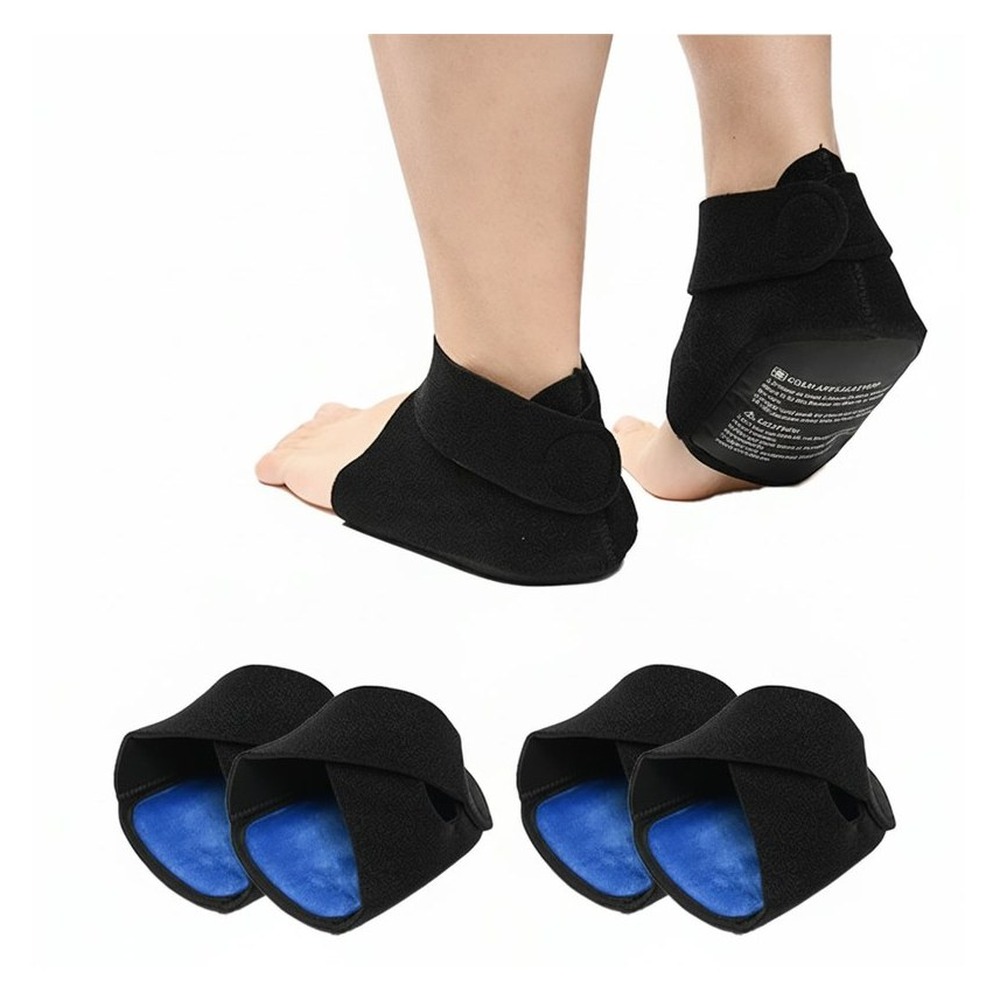
We make two versions: a PU gel pack in a neoprene sleeve and a perforated SEBS gel sleeve with air holes for longer wear.
- Freezer-safe PU gel packs
- Perforated SEBS gel sleeves
- Adjustable ankle strap
- Colour box with instruction leaflet
Materials & Construction
The PU pack feels cold and firm straight from the freezer; the perforated SEBS sleeve feels softer and lets heat escape during longer wear. The neoprene side faces out, and the gel side touches the skin.
Customisation & Packing
We print the logo on the sleeve and the box, supply a multilingual instruction leaflet, and can pack a pair with a mesh carry bag. Custom gel volume and sleeve colour are available. Packing runs through our packaging and branding service, with dielines and artwork handled by the private label team.
- Any solid colour, Pantone matched
- Logo deboss, print or woven label
- Retail box, hang card or pouch
- Barcode and FNSKU labelling
Made To Order: Specs, Packing & Lead Times
Hot and cold therapy is the bulkiest line: 500 pairs per carton at 58 x 42 x 36 cm, 18.4 kg and 0.088 CBM. A 20GP holds 318 cartons (159,000 pairs) and a 40HQ holds 772 cartons (386,000 pairs); the gel pack and the neoprene sleeve are packed together in one printed box.
Sample 7-10 days from a stock mould, 15-20 days with a new tool (including 10-15 days for the tool). Bulk 20-25 days for 500-3,000 units, 25-35 days above that. August to October adds 12-15 days.
Materials & Compliance
PU gel packs are 1.4 cm thick and stay flexible at -18°C; SEBS gel sleeves run at 20 Shore A with a 2 mm neoprene backing. Seam strength is checked on every batch. The range pairs naturally with heel cups & grips: heel cups, sleeves and grips that stop slipping and arch support braces: wearable braces that hold the arch all day.
The compound is tested to ASTM D624 for tear strength and ASTM D412 for tensile strength and elongation; parts are aged at 70°C for 72 hours and must retain at least 80% of their elongation. Results are filed by batch.
MSDS, RoHS and REACH reports are issued per order, with the batch number on the inspection record. Third-party testing can be arranged before shipment.
Who Buys Gel Foot Therapy
Brands order a printed colour box with the sleeve, gel pack and a hot/cold instruction card, usually 500-1,000 sets. The box carries the brand, barcode and a freeze/heat icon, and the gel colour can match the brand.
Pharmacies and clinics take a clinic pack of five sets with no retail logo and a laminated instruction sheet; they ask for a gel pack that stays flexible at 0 C and a sleeve that can be wiped clean between patients.
Chain retailers need a box that stands on a shelf, a barcode and a shelf-ready carton, with the freeze/heat use visible on the front panel. Retail runs are 1,000-3,000 sets per style.
Distributors mix hot-cold and air-hole sleeves in one container and ask for a price step at 5,000 and 20,000 sets; the heavier gel cartons are stacked separately to keep the container within weight limits.
Physiotherapy suppliers order a clinic kit of four sleeves and two gel packs, packed in a wipe-clean bag with a laminated protocol card. The kit is assembled at the packing line, carries a batch label for traceability, and the gel packs are shipped flat so they freeze evenly in a clinic freezer.
Start with the OEM manufacturing service overview, or read the low MOQ programme for runs from 500 pieces.
Frequently Asked Questions
How long should the pack be frozen?
Can the sleeve be worn on either foot?
Can the gel pack be replaced separately?
What is the MOQ and the tooling cost for a new shape in gel foot therapy?
Can you supply gel foot therapy under our brand with retail-ready packaging?
Start Your Custom Foot Care Project Today!
Send us a sample, a drawing or a competitor product with the quantity and the market you sell into. We will reply within 24 hours with a construction, a price band and a sampling plan.