Custom Forefoot Pads
Forefoot pads spread pressure under the metatarsal heads and stop the toes rubbing. The honeycomb structure compresses and springs back, which is why it works better than a flat pad for people who stand all day.
What We Make In Forefoot Pads
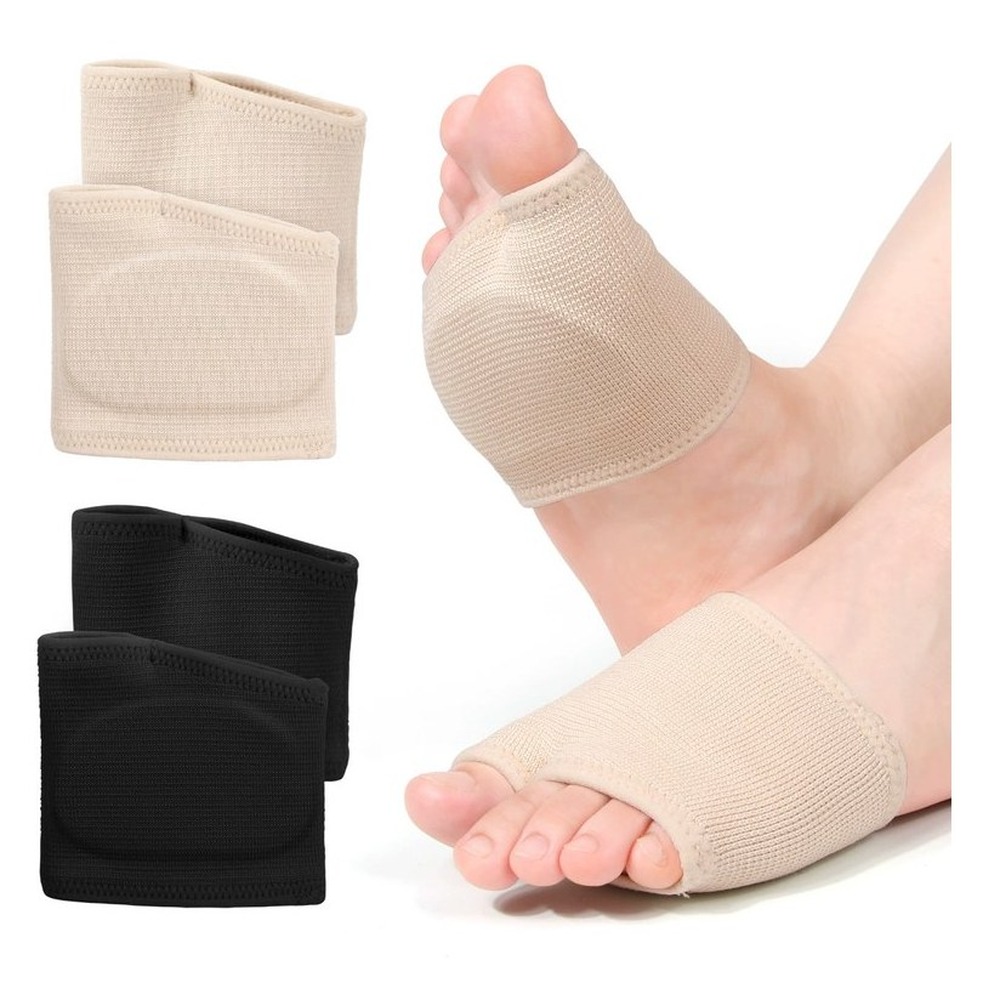
We make a five-hole pad, a five-loop cushion and a full forefoot sleeve, so you can cover entry-level and premium price points from one supplier.
- Honeycomb and gel cushioning
- Five-toe loop and sleeve designs
- Slim enough for most shoes
- Any solid colour with logo
Materials & Construction
Honeycomb SEBS feels soft and springs back under the ball of the foot; silicone feels firmer and keeps a flatter platform. The fabric-covered sleeve feels smoothest against bare skin and is the one to air dry.
Customisation & Packing
Colour matching, a debossed logo, hang cards and poly bags are all standard. A version with six removable pressure plugs can be supplied for a tiered range. Packing runs through our packaging and branding service, with dielines and artwork handled by the private label team.
- Any solid colour, Pantone matched
- Logo deboss, print or woven label
- Retail box, hang card or pouch
- Barcode and FNSKU labelling
Made To Order: Specs, Packing & Lead Times
Pads pack 1,000 pieces per carton at 48 x 34 x 30 cm, 9.6 kg and 0.049 CBM. A 20GP holds 571 cartons (571,000 pieces) and a 40HQ holds 1,387 cartons (1,387,000 pieces). The slanted-cut sleeve is bulkier at 500 pairs per carton and 0.066 CBM.
Sample 7-10 days from a stock mould, 15-20 days with a new tool (including 10-15 days for the tool). Bulk 20-25 days for 500-3,000 units, 25-35 days above that. August to October adds 12-15 days.
Materials & Compliance
SEBS honeycomb runs at 20 Shore A with a 4 mm pitch; silicone cushions at 25 Shore A and 3.5 mm; gel sleeves use a 15 Shore A gel with a 0.6 mm fabric cover. The range pairs naturally with toe protectors: sleeves and caps for corns and blisters and heel cups & grips: heel cups, sleeves and grips that stop slipping.
The compound is tested to ASTM D624 for tear strength and ASTM D412 for tensile strength and elongation; parts are aged at 70°C for 72 hours and must retain at least 80% of their elongation. Results are filed by batch.
MSDS, RoHS and REACH reports are issued per order, with the batch number on the inspection record. Third-party testing can be arranged before shipment.
Who Buys Forefoot Pads
Brands order pads and sleeves in a printed box with a foot diagram and a size guide, usually 2,000-5,000 pieces. The box carries a barcode and the brand, and the pad is visible through a window.
Pharmacies and clinics buy 10-piece clinic packs with no logo and a simple fitting card; they prefer a washable pad and a clear indication of forefoot versus heel use.
Chain retailers need a hang card with the pad shape visible, a barcode and a shelf-ready carton. The card is printed with the size and the arch or forefoot use so the customer can choose at the shelf.
Distributors mix honeycomb pads, sleeves and metatarsal cushions in one container and ask for a price step at 20,000 and 50,000 pieces; cartons are marked by shape and size for easy splitting.
Sports retailers ask for a two-pack of honeycomb pads with a sweat-resistant card, because the pad is bought as a repeat item rather than a one-off. The card is laminated, the barcode sits on the back panel, and the two-pack is sized to hang on a peg beside insoles and heel cups without a bespoke display. The two-pack is also listed as a single unit for pharmacy chains.
Start with the OEM manufacturing service overview, or read the low MOQ programme for runs from 500 pieces.
Frequently Asked Questions
Can the pad be trimmed?
Do you offer a version with pressure plugs?
Can the pad be washed and re-used?
What is the MOQ and the tooling cost for a new shape in forefoot pads?
Can you supply forefoot pads under our brand with retail-ready packaging?
Start Your Custom Foot Care Project Today!
Send us a sample, a drawing or a competitor product with the quantity and the market you sell into. We will reply within 24 hours with a construction, a price band and a sampling plan.